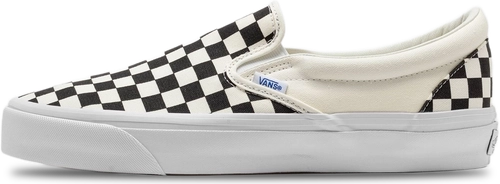
Vans Slip-On: price, colorways, and where to buy
The Vans Slip-On is a low-profile, laceless canvas shoe that debuted in 1979, originally designed for skateboarding and instantly recognizable by its clean silhouette and waffle sole. Initially released as the Vans #98 in Southern California, it has become a staple of the Classics lineup alongside the Old Skool and the Authentic. Its minimalist construction and iconic checkerboard pattern have made it a silhouette recognized far beyond the skate scene, embodying California skate culture all on its own.
Why the Vans Slip-On Has Stood the Test of Time Since 1979
Originally, the Slip-On was created to meet a very specific need of skateboarders in Southern California: a shoe that slips on without laces, with a grippy waffle sole that sticks to the board, and a durable canvas upper. The design was purely functional, and it's this raw efficiency that explains its longevity.
The turning point came in 1982. That year, Jeff Spicoli wore a black and white checkerboard pair in Fast Times at Ridgemont High, and the silhouette moved from the skate scene into American pop culture. The sneaker became as much associated with a character as it was with a practice. Since then, the Slip-On from Vans has remained in continuous production, and the checkerboard pattern has survived all fashion cycles without ever leaving the Classics catalog.
How the Vans Slip-On is Built
The Vans Slip-On we know today stays true to the original: a minimal upper, a vulcanized sole, and zero technical frills. This simplicity is what places it at the bottom of the Classics price range, alongside the Authentic and below the Old Skool or Sk8-Hi.
The detail that sets the Slip-On apart from other Classics isn't immediately obvious: it's the elastic side panels. More than just a slipper, these are what actually hold the foot in place once the canvas softens, and they explain why a well-fitted Slip-On doesn't sag after a few weeks.
Official verified features:
- Upper: low-top canvas
- Slip-on system: elastic side panels
- Collar: padded, no laces
- Outsole: waffle rubber
- Signature print: black and white checkerboard
To place the Slip-On in the lineup: the Vans Old Skool adds laces, the sidestripe, and a suede reinforcement at the toe, which justifies the retail price difference.
What size to get for the Vans Slip-On
Sizing verdict: TTS (True To Size) for most, half a size down if you have a narrow foot or slim ankle.
The official Vans chart indicates a TTS fit, and that's also the majority verdict from feedback. However, there's a nuance: the canvas softens after a few weeks, and a pair that feels too loose at first can become baggy over time.
The toe box of the Slip-On is slightly wider than that of the Old Skool, Authentic, or the Vans Era 95. So, a wide foot can stay TTS without feeling cramped at the front. In terms of length, though, all Vans Classics fit the same: a Slip-On in size 42 will have the same length as an Old Skool in size 42.
Price and Where to Buy the Vans Slip-On
The Vans Slip-On Classic retails for €80 on the official Vans website in France, making it one of the most accessible entry-level options from the brand. The Platform and Premium versions go for more, ranging from €90 to €110 depending on the finish.
In terms of distribution, the Slip-On is a general release (GR) in the broadest sense: available year-round at major retailers, continuously restocked. This is why price differences between retailers remain tight, and why older colorways or less popular sizes drop quickly during sales.
FAQ
Does the canvas of Vans Slip-Ons stretch over time?
Yes, and that's by design. The natural canvas softens after a few weeks of wear, making the sneaker more comfortable but also a bit looser to slip on. The elastic side panels compensate for this looseness and continue to hold the foot in place, as long as you got the sizing right from the start.
What's the difference between the Classic Slip-On and the Platform Slip-On?
The Classic Slip-On has a standard vulcanized sole that's about two centimeters thick. The Platform Slip-On features the exact same upper but is built on a taller and thicker sole, usually between four and five centimeters. The sizing remains the same between the two versions; only the height changes.
Is the Vans Slip-On still suitable for skating today?
It remains skateable thanks to its waffle sole and vulcanized construction, but Vans has since developed dedicated lines (Pro, BMX) with cushioning and reinforcements designed for impact. For everyday use on the board, these Pro versions are more durable. The Classic Slip-On, on the other hand, is mainly for lifestyle.
How do you maintain a light-colored Vans Slip-On?
The white or light canvas can be cleaned with a soft brush and a bit of soap and warm water, without machine washing, which weakens the vulcanized glue and yellows the sole. A fabric water repellent applied right after purchase helps limit stain absorption on light canvases.